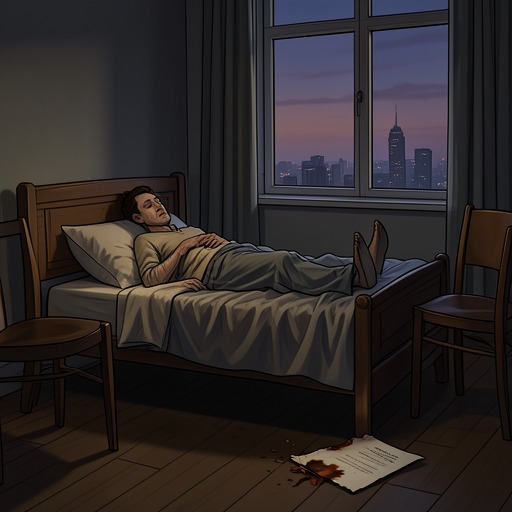
Lin Yanche’s manic episodes and mental instability
CEO's Beloved Honey GirlLin Yanche’s manic episodes and mental instability form a recurring state of physical pain, emotional volatility, and impaired self-control. The condition is not confined to one dramatic breakdown: it appears in worsening headaches, disturbed nights, the need for medication, hospitalization, and sudden movements from apparent stillness to threatening pursuit. Through him, the narrative makes psychological instability visible as a force that damages relationships, alarms allies and enemies alike, and leaves care entangled with fear.
Identity and Clinical Presentation
Lin Yanche’s instability is first registered through the body. After leaving the Lin residence, he sits in his car for a long time without starting the engine because a severe headache has overtaken him. The headaches have recently become worse, and his nights are disturbed by the habitual impulse to reach toward the woman beside him for help obtaining medicine. The repetition matters: even sleep does not release him from the condition, and the imagined presence of another person becomes part of how he manages pain.
His deterioration eventually leads to hospitalization. When Su Xiangcheng learns that Lin Yanche is in the hospital, she is surprised that someone she regards as physically formidable could be confined to a ward. The narrative immediately complicates that image by describing him as so manic that objects can be heard falling inside the room from the doorway. The hospital therefore becomes less a place of calm recovery than a visible boundary around behavior that has become difficult to contain.
Episodes of Escalation and Loss of Control
Lin Yanche’s manic state is especially dangerous when it turns outward. While Su Qingrou is trying to leave after her operation, he discovers her and abruptly releases her only to threaten that the matter is not finished. Lu Xun orders him not to go crazy and urges him to take his medicine, but Lin Yanche has already run after the woman who disappeared. The sequence compresses medical fragility and aggressive momentum into the same scene: an injured or recently operated body does not prevent him from pursuing another person, and medication becomes an urgent attempt to interrupt escalation rather than a routine detail.
His conduct also affects the people around him through anticipation. When Lu Xun arrives at the ward, Lin Yanche quickly interprets Lu Xun’s condition as evidence of a quarrel with Su Xiangwan and directly asks whether Lu Xun has acted against her. After hearing that Lu Xun cannot find her, Lin Yanche responds with cold suspicion, assuming that Lu Xun’s conduct must have driven her into hiding. His judgment is not detached; it is shaped by a worldview in which intimacy, injury, and retaliation are tightly connected. The exchange shows him moving from observation to accusation with little emotional distance.
Lin Yanche’s warning about Su Xiangwan’s physical weakness intensifies that atmosphere. He tells Lu Xun that she suffers severely during menstruation, that influenza strikes her hard, and that a cold can leave her feverish for three days and three nights. He then advises Lu Xun to prepare to identify her body. The statement is cruelly phrased, but it also reveals how readily Lin Yanche converts concern into menace. Lu Xun’s heart reacts with sudden pain and his face turns deathly pale, demonstrating that Lin Yanche’s instability does not remain within his own body; it spreads as terror through the room.
Relationships, Care, and Containment
Su Qingrou’s visit to Lin Yanche’s ward illustrates the unstable boundary between attachment and avoidance. She sits quietly beside his bed because she has promised Jun Xi that she would come, yet she does not want to face Lin Yanche while he is conscious. To make the visit possible, she has the doctor inject him with Valium. The act is neither simple rejection nor simple tenderness. She keeps her promise and enters the ward, but only by arranging for him to remain unconscious, turning medical sedation into a condition of emotional safety.
Her restrained contact with him carries the same ambivalence. She observes that he has become very thin and reaches toward his face before withdrawing her hand. The gesture acknowledges his deterioration while refusing uncomplicated intimacy. Her silence, followed by a sudden laugh, leaves the scene emotionally unresolved. Lin Yanche’s condition has made direct conversation difficult, so his sleeping body becomes the object through which Su Qingrou can express concern without surrendering control of the encounter.
Lu Xun occupies a different position: he confronts Lin Yanche when necessary, but he also understands that the instability cannot be treated as mere bad temper. His command to take medicine is an attempt at immediate containment. Later, when Su Xiangwan collapses from fever at an elevator entrance, Lu Xun is himself injured, with blood still at the corner of his mouth, yet he crouches beside her, embraces her, and reassures her that he is there. In the surrounding narrative, Lin Yanche’s warnings about bodily vulnerability and Lu Xun’s response to it establish a contrast between destructive alarm and protective action.
Trauma, Illness, and the Limits of Explanation
The text places Lin Yanche’s instability within a wider field of concealed or belated trauma. Su Xiangcheng recalls that her mother had a terminal illness and walked onto a balcony after seeing a childhood drawing of the family holding hands. The memory links illness, guilt, family secrecy, and suicide, showing that the story’s emotional injuries are inherited through silence as much as through direct violence. Lin Yanche’s own behavior belongs to this same damaged world, although the supplied scenes do not reduce his manic episodes to one single cause.
Lu Xun’s account of being kidnapped at twelve provides another important parallel. He remembers being drugged by the kidnappers and nearly losing his life, after which he became resistant to all drugs. He narrates the ordeal with an unwavering gaze, as though describing someone else, suggesting the emotional distance created by an old but unforgettable wound. Against this history, Lin Yanche’s need for medicine and Valium carries a sharper significance: treatment is present, but it does not automatically restore safety, trust, or control.
The condition is also complicated by serious physical disease. Yun Xiao reveals that Lin Yanche has liver cancer and is waiting for a suitable organ source; without one, he can only wait for death. His extreme thinness is retrospectively reinterpreted through that diagnosis. The body that appears manic, restless, and threatening is also a body undergoing fatal deterioration. This convergence prevents the narrative from treating his instability as purely theatrical villainy: illness, pain, dependency, and aggression occupy the same failing body.
Narrative Function and Significance
Lin Yanche’s manic episodes repeatedly interrupt the fantasy that powerful men can remain invulnerable. He is associated with physical force and emotional danger, yet the narrative shows him immobilized by headaches, dependent on medicine, sedated by others, hospitalized, and visibly diminished by cancer. His instability exposes the weakness beneath the image of control, but it does not make him harmless. The same condition that produces suffering also fuels pursuit, threats, and frightening unpredictability.
His episodes further organize the novel’s recurring pattern of trauma returning through behavior rather than orderly confession. Pain surfaces as a headache, a sleepless reach for medicine, a ward filled with falling objects, a sudden chase, or a warning that sounds like a curse. Other characters respond by fleeing, sedating him, commanding him to take medication, or physically shielding someone from danger. The result is a cycle in which care becomes necessary precisely because trust has been damaged, while control becomes indistinguishable from another form of threat.
By the time his liver cancer is disclosed, Lin Yanche’s mental instability has acquired a tragic final pressure. He is not merely losing command of his actions; he is also confronting a body that may have no future without a transplant. The narrative therefore binds manic crisis to mortality: his rage and pursuit are immediate, but the deeper horizon is death. That tension gives the condition its lasting significance, making Lin Yanche both an agent of danger and a visibly deteriorating figure whose violence cannot be separated from the wounds and bodily limits that surround him.